
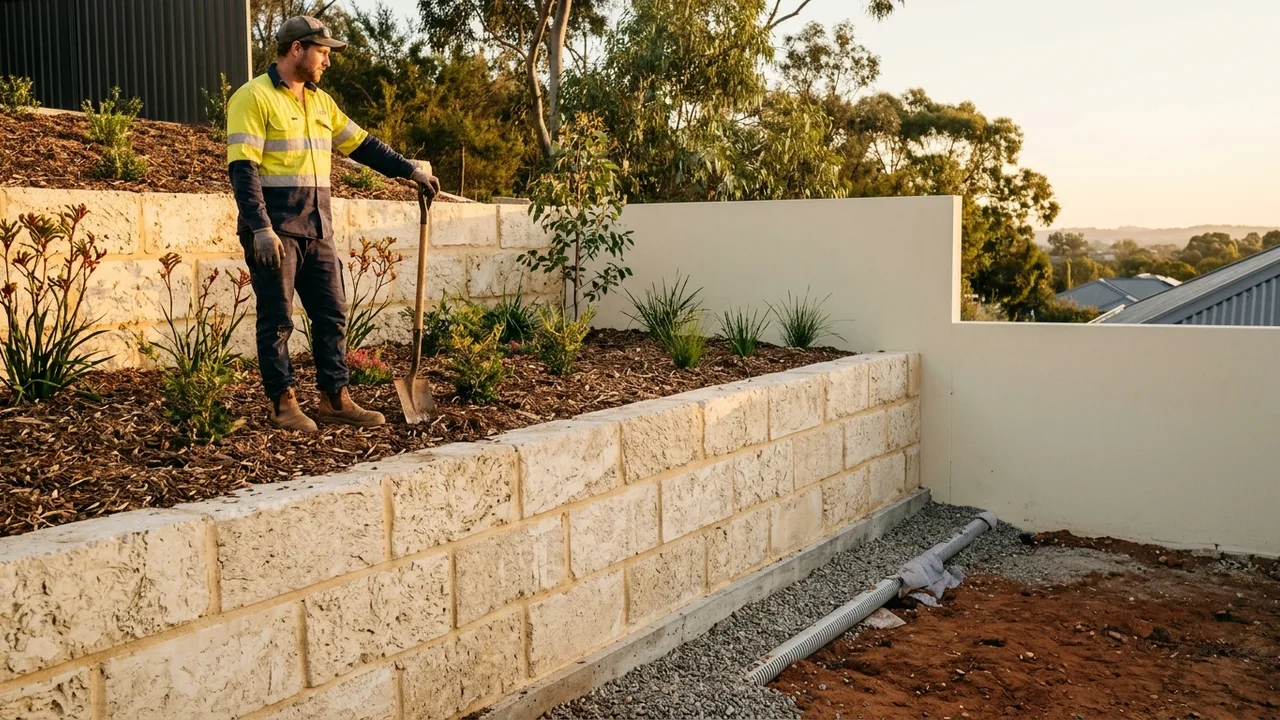
Retaining Walls in Perth, WA: Landscaping for Sloping Blocks
Sand keeps washing off your slope and the ground is too steep to use. A well-built retaining wall gives you level ground with drainage behind it.
Retaining walls in Perth hold back sandy soil so a sloping block becomes level, usable ground and stops sending sand across your paths. The wall can be limestone, timber sleepers or posts with panels. What matters most is the footing and the drainage behind it.
What is included
- Limestone walls Stacked or block limestone suits front yards and garden beds where the wall stays on show.
- Sleeper walls Timber sleepers suit lower drops and garden edges and are usually quicker to build, though timber rots sooner than concrete where the soil stays damp.
- Post and panel walls Steel posts hold sleepers or concrete panels, which suits taller drops and heavier soil loads.
- Drainage and footings A drain pipe at the base, stone backfill and an outlet that carries water away from your house and the neighbour's.
- Levelling and cut and fill Reshaping the ground leaves a flat pad for lawn, paving or an outdoor living area.
How it works
-
Measure the drop
The landscaper works out the wall length, how far the ground falls and what sits at the top, such as a driveway, a fence or the house. Those details point towards limestone, sleepers or post and panel.
-
Price and permit in writing
The quote sets out the scope before any digging, including footings and drainage. Walls near a boundary or under a driveway can draw a building permit, so that is settled before the first trench.
-
Build from the footing up
The landscaper digs the footing, builds the wall, lays the drain and backfills with free-draining stone. Soil is then shaped and lawn or garden beds go in on level ground.
Retaining walls in Perth: holding back sand on a sloping block
A retaining wall holds soil at two levels so the higher side stops sliding down. On Perth's sandy ground that matters, because loose sand moves with every downpour and washes over paths, paving and into the next yard.
Once the wall is in, a slope becomes a flat pad you can lay lawn or a patio on. Coastal erosion is a different problem on exposed blocks closer to the coast, because wind lifts sand as well as rain washing it. The wall holds the face of the slope, and planting or mulch on top stops the wind stripping the surface.
Limestone, sleeper or panel: which wall suits your block and ground
Wall height and access usually settle the choice. Limestone suits a wall that stays on show, and sleepers stacked on their own suit low garden walls. Concrete sleepers outlast timber in damp soil, while timber costs less to start with.
For taller drops, a post and panel wall sits sleepers or concrete panels between steel posts set deep in concrete. Where a wall carries a driveway, a fence or a heavy soil load, an engineer usually sizes the posts and footings. If machines cannot reach the site, that also shapes the material, because everything has to be carried in by hand.
Earthworks and ground preparation: drainage that keeps the wall standing
Drainage is what keeps a wall standing. Water trapped behind a wall pushes on it far harder than dry sand does, and a wall without drainage is the one that leans or cracks.
Free-draining stone behind the wall lets water drop straight to the pipe at the base, where packed site sand can hold it against the wall instead. Cutting and levelling the ground before the wall goes up is part of the same job.
Approvals and registration for walls in WA
A retaining wall in WA can need a building permit, but retaining walls and timber decking are exempt from builder registration, even on permit work worth $20,000 or more. A wall built alone under a separate contract is also exempt from home indemnity insurance.
Your local council is the usual starting point for permits and planning matters. A tall wall, one near a boundary or one holding up a driveway is the kind that draws the most attention.
What drives the cost of a retaining wall
Wall height and length drive the price most, because taller walls need deeper footings, more drainage and often engineering. Material comes next, since limestone, sleepers and post and panel each cost differently to supply and build.
Access matters too. A wall that machines can reach costs less than one built with materials carried in by hand. A written quote sets out the scope, so two quotes that differ sharply are usually pricing different walls, with different footings or drainage.
Stepping a steep block with low walls
A steep block does not always need one tall wall. Two or three low walls stepped across the slope make garden tiers that are easier to build and give you planting beds, a lawn or a seating area.
The result is level ground you use on summer evenings, with sandy soil held in place. When the same landscaper handles design and build, the wall, drainage and garden levels stay lined up.
Slope still shedding sand onto the paving? Say how far the ground drops, what sits on top and whether machines can get in, then request a Project Review.
Retaining walls options
- Limestone retaining walls Stacked or block limestone for sloping front and back yards.
- Sleeper and panel retaining walls Timber or concrete sleepers between posts for longer runs.
- Tiered garden walls Low walls stepped across a slope to form planting beds.
- Erosion control for sandy and coastal blocks Walls and planting that hold loose sand against wind and water.
Retaining walls across Perth
Frequently Asked Questions
Does a retaining wall over $20,000 in WA need registration and home indemnity?
When does a retaining wall in Perth need a building permit or planning approval?
Do landscapers warranty their retaining wall construction?
Get it priced
Yard baking in the heat or sitting unused? Tell us what you want and get a clear price to work from.
Tell us what you need done and we'll send you a price.