
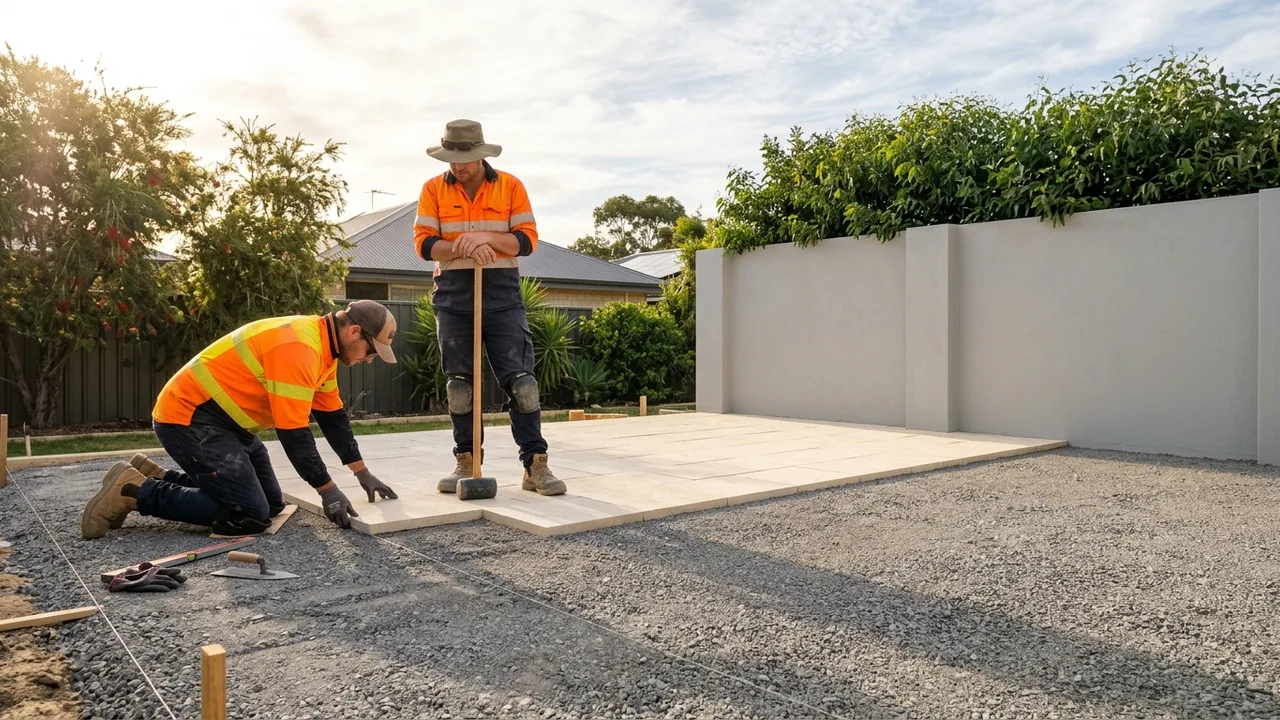
Paving in Perth, WA: Landscaping for Patios and Paths
Pavers lifting or sinking on sand? Paving in Perth lasts when the base is built right, and the material follows from there.
Perth sand drains fast and shifts under weight, so a thin or poorly compacted base is the usual reason pavers dip, rock or open up at the joints. Get the base right for how the area will be used, and the surface you pick comes second. Brick, limestone and exposed aggregate concrete all work here. Each suits a different job, budget and look.
What is included
- Patios and alfresco areas A patio carries people, furniture and a barbecue rather than a car, so it needs a firm base but not the depth of crushed rock a driveway does.
- Paths and entries On sand, a path depends on restrained edges more than depth, because sand creeps sideways into lawn and beds.
- Driveways and parking bays Load concentrates where wheels turn and where the car stops, so the tight curve near the gate or the garage mouth is where weak joints open first.
- Pool surrounds Falls should run away from the water, and a textured, paler finish keeps wet feet steady and bearable in summer.
- Repairs to lifted or sunken paving Once the cause is found, many areas can be re-levelled on a better base and relaid with the same pavers.
How it works
-
Look at the site
A local landscaper visits the area, notes how the ground falls and sees what stands there now, including trees, walls and downpipes.
-
Agree material and layout
You settle on brick, limestone or exposed aggregate, the pattern, the edge detail and where water should run.
-
Written price
The quote sets out the scope and cost in writing before any digging begins.
-
Excavate and build the base
Old surface and loose sand come out, then crushed rock goes in and is compacted in layers to the depth the use demands.
-
Lay, joint and finish
Pavers are laid to a fall, edges are restrained and joints are filled so the surface locks together.
Paving in Perth: what lasts on sandy ground
The base is what lasts. Pavers themselves rarely fail. What fails is the layer under them, because Perth sand compresses unevenly when it is wet, dries out in summer and moves when nothing holds it in.
A sound job removes the loose top layer, lays crushed rock and compacts it in stages. A patio needs a lighter build than a driveway, which has to carry a car parked in the same spot every night.
Edges matter just as much. Without a firm restraint around the outside, pavers creep outwards and the joints open.
Limestone, brick and exposed aggregate concrete compared
Limestone is a local stone with a soft, pale look. It suits patios and garden paths and stays cooler than dark surfaces, though it can stain and wears faster under vehicles.
Brick pavers are small units that move a little with the ground without cracking. That makes them forgiving on sand, and a few damaged bricks can be swapped out later. Patterns such as herringbone also lock together under driveway loads.
Exposed aggregate concrete is poured in one slab with the top washed back to reveal the stones. It grips well when wet, which suits pool surrounds and sloping driveways. Its weakness is that a crack cannot be lifted out like a single paver, so control joints and a solid base matter.
Earthworks and ground preparation for paving
Water is the second thing that moves a paved area. Paving should fall gently away from the house, with downpipes and stormwater directed to soakwells (underground pits that let rainwater soak away) rather than pooling at the edge.
On a sloping block, sand washing onto a path often points to the ground above the paving as well. A small retaining wall or a graded garden bed can hold the soil back so the new surface stays clean.
Where paving meets a lawn or garden, a neat edge detail keeps sand out of the joints.
What drives the cost of paving
Paving in Perth typically runs from $80 to $200 per m² (October 2026). The spread is wide because the price follows several things at once.
Material is one. Limestone, brick and exposed aggregate each sit at a different point in the range. Base depth is another, since a driveway needs more excavation and crushed rock than a path. Access, old surfaces to remove, tight corners and cut patterns also add labour.
A full landscaping job, which includes paving along with planting and other elements, typically starts from about $120 per m² (October 2026). The written quote sets out the scope and the price before work starts, so you can plan your budget and payments.
Trees, walls and slopes beside your paving
Tree roots are a common reason paving lifts near a large tree. Roots follow moisture and loose ground, and as they thicken they push up whatever sits above them. The fix depends on the tree, how close it is and how deep the base goes.
Retaining walls often sit beside paving on sloping blocks. Walls in Perth typically cost $250 to $700 per m² of wall face (October 2026). Some retaining walls and decks may need a building permit, so settle the scope with your local council before the quote is signed.
Mistakes that cause paving to lift or sink
A shallow base laid to save money is the main one. It looks fine for a season, then dips where the chairs or the car sit.
Laying pavers straight onto loose sand, skipping edge restraints and ignoring where roof water goes are the others.
A quote far below the others often means a thinner base or no removal of the old surface. Ask the landscaper what depth of crushed rock goes under your paving and how the edges are held. The answers show how long the job will last.
Paving dipping near the gate or holding water by the back door? Type in what it is doing, how big the area is and how the ground falls, then request a project review for a clear price to fix the base properly, not just the surface.
Paving and paths options
- Brick and clay paving Clay bricks come in reds, browns and creams, and the colour is fired right through, so a scuffed edge does not show a different layer.
- Limestone paving Sealing before first use keeps oil, drinks and barbecue fat from soaking in, and a textured finish gives better grip near the pool.
- Exposed aggregate concrete The stone mix and how far the surface is washed back set the colour and the feel underfoot, so a gentler finish suits bare feet on a patio.
- Paver repair and relaying Starts with finding why the paving sank, whether a weak base, roof water or a tree root, so the same fault does not return.
Paving and paths across Perth
Frequently Asked Questions
What does paving and landscaping cost per square metre in Perth?
Can lifted or sunken paving be repaired instead of rebuilt?
Why are trees lifting the paving in my Perth garden?
Get it priced
Yard baking in the heat or sitting unused? Tell us what you want and get a clear price to work from.
Tell us what you need done and we'll send you a price.